



Crafting a CV for a government position is not the same as applying for a private company job. Public sector recruitment is often strict, detail-oriented, and guided by specific criteria.
This means your CV must go beyond listing qualifications, it must demonstrate credibility, structure, and relevance.
Whether you are targeting a federal agency in Nigeria or an international government department abroad, here’s how to write a CV that stands out.
What Makes a Government CV Different?
A government CV is a detailed document that highlights your professional background, qualifications, and achievements, tailored specifically for a government role.
Unlike regular CVs, which may focus on brevity and creativity, a government CV demands structure, facts, and measurable accomplishments.
Recruiters in government agencies typically review applications alongside official guidelines and conduct background checks, so every piece of information you include must be accurate and verifiable.
Step-by-Step Guide to Writing a Government CV
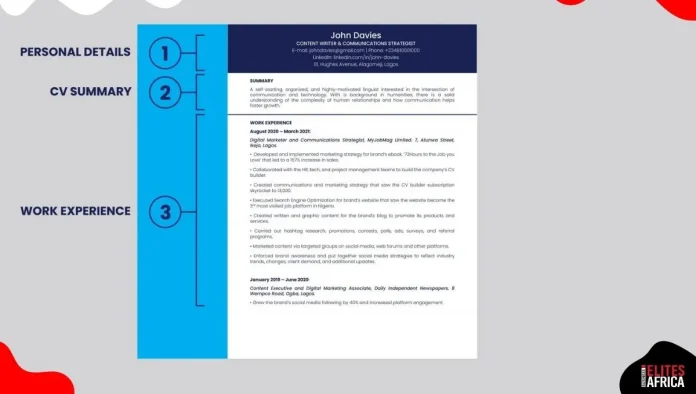
1. Start with Accurate Contact Information
Begin with your full name, phone number, email address, and location (city and state). Accuracy is key here. If any contact detail is incorrect, you could miss out on critical communication from HR.
2. Write a Professional Profile
Your professional profile (or summary) is a short paragraph that introduces who you are and what you bring to the table. Keep it clear and focused on your strengths relevant to public service, mention your experience, top skills, and career goal.
Example:
“A detail-oriented administrative professional with over five years of experience in public sector project coordination and policy documentation, seeking to contribute to efficient governance and service delivery.”
This short summary helps recruiters quickly understand your value.
Detail Your Work Experience
Government recruiters value consistency and verifiable experience. List your past jobs in reverse chronological order, starting from your most recent role. For each job, include:
- Job title and employer’s name
- Dates of employment (month and year)
- Average weekly hours (if requested)
- Clear list of duties using keywords from the job description
- Major achievements or awards, preferably with numbers or results
For example, instead of writing “Handled office tasks,” say “Managed administrative operations that improved departmental workflow by 15%.”
This not only shows your responsibility but also demonstrates impact, something government HR teams look for.
List Your Educational Background
Education is a core requirement in most public sector roles. Include all relevant academic qualifications:
- Institution names
- Degree or certificate obtained
- Field of study
- Completion dates
- Honours or distinctions (if any)
- Relevant coursework or projects
If you studied abroad or took online programs that align with the job, include them as well. It shows initiative and a willingness to learn.
Use the Right Keywords
Most government recruitment portals use Applicant Tracking Systems (ATS), software that screens CVs for specific words before a human even sees them.
To pass this stage, carefully read the job description and use the same phrases it contains.
For instance, if a job ad mentions “budget monitoring” or “policy analysis,” include those exact terms in your CV where applicable.
Highlight Your Key Skills
Government roles often require a mix of technical and soft skills. Create a separate “Skills” section where you list relevant abilities, such as:
- Report writing
- Data analysis
- Communication and teamwork
- Public policy understanding
- Computer proficiency (e.g., MS Office, Excel, or database tools)
If you’ve gained unique or transferable skills from unrelated jobs, mention them too. For instance, learning a new system could translate into “fast learner” or “adaptable to change.”
Include Optional Additions That Strengthen Your CV
To stand out, you can add sections that give more insight into your professional growth and commitment. These may include:
- Security clearance level (if applicable)
- Professional affiliations (e.g., member of an administrative or accounting body)
- Certifications and training
- Volunteer experience
- Languages spoken
- Publications or research projects
- References (with names, positions, and contact details)
These details make your CV more robust and show that you bring more than just academic qualifications.