
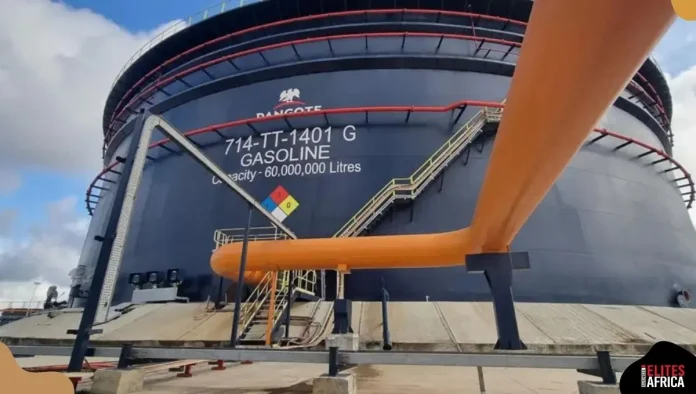



As fuel prices continue to rise across Nigeria, the Dangote Refinery has stepped forward to calm public anxiety, assuring that the country has no reason to fear scarcity. The refinery announced that it currently holds over 310 million litres of petrol in storage,
enough to meet both domestic and export demand.
Devakumar Edwin, the Vice President of the Dangote Group, made the clarification during a recent media tour of the refinery. He explained that the facility remains fully operational and urged fuel marketers to come forward and load products directly from the refinery.
“Bring your tankers. We will load. Any number of tankers you bring, we’ll load. No one can say we are not supplying,” Edwin declared. “We have more than 310 million litres as of now.”
Market Confusion and Price Surge
Over the past week, petrol prices have climbed sharply in many parts of the country moving from around ₦865 per litre to nearly ₦1,000 in some states like Lagos, Ogun, and Abuja.
The price hike was triggered by widespread rumours that the Dangote Refinery had halted fuel sales.
But Edwin dismissed those claims as “misinformation,” noting that the speculation pushed some filling stations to increase their pump prices unnecessarily.
“It’s just a campaign to make people panic,” he said. “We are still producing and loading. There’s no reason for prices to go up.”
Operational Challenges but No Shutdown
Reports had earlier surfaced that the refinery was slowing down crude oil purchases due to technical and operational issues. Data from Bloomberg showed that Dangote’s crude intake dropped to less than 300,000 barrels per day, about half of its July peak.
Edwin confirmed there had been temporary slowdowns caused by maintenance and routine adjustments but stressed that such occurrences were normal for a large industrial operation.
“No factory runs at 100 percent every day without a problem,” he explained. “Turnaround maintenance is part of our process. What matters is that production continues.”
Assurance of Steady Supply
The refinery’s management reiterated that its current stock level and ongoing production guarantee a steady flow of petrol into the Nigerian market.
Edwin also explained that fluctuations in crude intake were due to careful inventory management, not financial or production distress.
“When prices are low, we buy more crude. But when our inventory is full, we slow down a bit because crude oil is money locked up in storage,” he clarified.
Despite challenges, the refinery continues to refine and distribute petrol daily, supported by a new crude supply deal with the Nigerian National Petroleum Company (NNPC), which now provides about 150,000 barrels per day.