
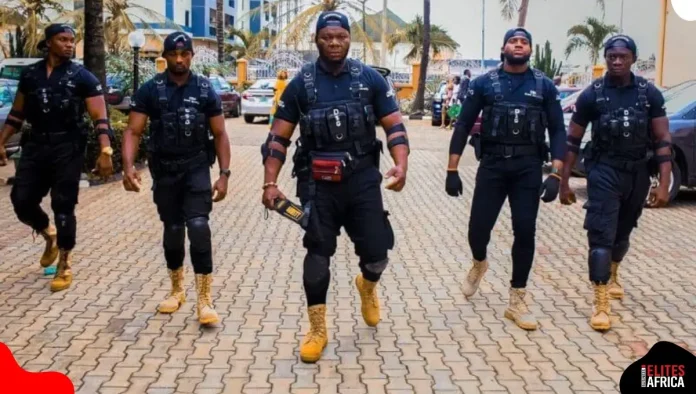



At the Interior Ministry’s mid-tenure retreat in Suleja, Minister Olubunmi Tunji-Ojo backed a repeal of the 1986 Private Guards Act so that vetted private security firms can carry firearms, arguing that Nigeria’s 230-million population has outgrown an unarmed private guard model.
He proposed a split-oversight system: the Office of the National Security Adviser (ONSA) would profile, vet and license armed companies, while the Interior Ministry would handle corporate licensing.
Two laws set today’s ground rules:
- Private Guard Companies Act (1986; Cap. P30, LFN 2004). This governs licensing of private guard firms and, in practice, keeps private guards unarmed. Licensing is supervised by the Ministry of Interior (with operational oversight often interfacing with NSCDC).
- Firearms Act (Cap. F28, LFN 2004). This controls who may possess firearms. No one may have a gun without a federal licence, and the Act sets strict conditions for sale, storage, and records. This high bar is why private guards generally do not carry guns.
What the minister is proposing
The Interior Minister backs a repeal and re-enactment of the 1986 law to allow a narrow class of vetted, trained companies, not all guards, to carry firearms under strict conditions.
He also outlined split oversight: the Office of the National Security Adviser (ONSA) would handle profiling, vetting, and weapons licensing, while the Ministry of Interior continues corporate licensing.
Most measures would need parliamentary approval and detailed rules before implementation.
What must change for an “armed private” model to work
- Align the laws: Even if the Private Guards law changes, the Firearms Act still governs possession. Reform must clarify who licenses companies and personnel, what weapon classes are allowed, how arms are stored and tracked, and what reporting goes to the police and ONSA.
- Set hard entry standards: Require rigorous background checks, minimum training hours with annual re-qualification, psychological screening, armoury standards and chain-of-custody logs, body-worn cameras/GPS where appropriate, and mandatory insurance with clear liability rules.
- Build independent accountability: Misuse of force should trigger fast, transparent investigations outside company hierarchies, with penalties up to licence revocation for firms and individuals. A public complaints channel and incident database would help build trust.
- Start with pilots: Limited pilots (e.g., industrial parks or critical corridors) let regulators test training, storage, and reporting before scaling nationally.
How other countries frame it
There’s no single global model. The UK keeps private security unarmed on land, with narrow, tightly controlled exceptions at sea. South Africa allows armed private officers within a dense regulatory regime. Nigeria must pick a model and resource regulators to match the choice.
Potential benefits—and risks to manage
Potential gains: Faster response for estates, businesses, and industrial zones; relief for overstretched public agencies; possible reduction in losses and insurance costs.
Risks: Weapon diversion or theft, excessive force, uneven training, and blurred lines of authority. Paper rules won’t suffice, private security in Nigeria would need well-staffed inspectors, digital registries, random audits, and swift sanctions.