
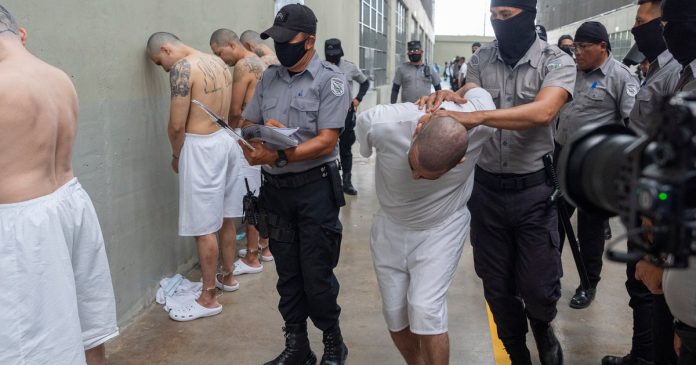


WASHINGTON (AP) — The government of El Salvador has acknowledged to United Nations investigators that the Trump administration maintains control of the Venezuelan men who were deported from the U.S. to a notorious Salvadoran prison, contradicting public statements by officials in both countries.
The revelation was contained in court filings Monday by lawyers for more than 100 migrants who are seeking to challenge their deportations to El Salvador’s mega-prison known as the Terrorism Confinement Center, or CECOT.
The case is among several challenging President Donald Trump’s immigration crackdown.
“In this context, the jurisdiction and legal responsibility for these persons lie exclusively with the competent foreign authorities,” Salvadoran officials wrote in response to queries from the unit of the U.N. Office of the High Commissioner for Human Rights. The U.N. group has been looking into the fate of the men who were sent to El Salvador from the United States in mid-March, even after a U.S. judge had ordered the planes that were carrying them to be turned around.
The Trump administration has argued that it is powerless to return the men, noting that they are beyond the reach of U.S. courts and no longer have access to due process rights or other U.S. constitutional guarantees.
But lawyers for the migrants said the U.N. report shows otherwise.
“El Salvador has confirmed what we and everyone else understood: it is the United States that controls what happens to the Venezuelans languishing at CECOT. Remarkably the U.S. government didn’t provide this information to us or the court,” American Civil Liberties Union lawyer Lee Gelerent said in an email.
Skye Perryman, CEO and president of Democracy Forward, said the documents show “that the administration has not been honest with the court or the American people.” The ACLU and Democracy Forward are both representing the migrants.
The administration in March agreed to pay $6 million for El Salvador to house 300 migrants. The deal sparked immediate controversy when Trump invoked an 18th century wartime law, the Alien Enemies Act, to quickly remove men it has accused of being members of the Venezuelan gang Tren de Aragua.
20 Years Of Free Journalism
Your Support Fuels Our Mission
Your Support Fuels Our Mission
For two decades, HuffPost has been fearless, unflinching, and relentless in pursuit of the truth. Support our mission to keep us around for the next 20 — we can’t do this without you.
We remain committed to providing you with the unflinching, fact-based journalism everyone deserves.
Thank you again for your support along the way. We’re truly grateful for readers like you! Your initial support helped get us here and bolstered our newsroom, which kept us strong during uncertain times. Now as we continue, we need your help more than ever. We hope you will join us once again.
We remain committed to providing you with the unflinching, fact-based journalism everyone deserves.
Thank you again for your support along the way. We’re truly grateful for readers like you! Your initial support helped get us here and bolstered our newsroom, which kept us strong during uncertain times. Now as we continue, we need your help more than ever. We hope you will join us once again.
Support HuffPost
Already contributed? Log in to hide these messages.
20 Years Of Free Journalism
For two decades, HuffPost has been fearless, unflinching, and relentless in pursuit of the truth. Support our mission to keep us around for the next 20 — we can’t do this without you.
Support HuffPost
Already contributed? Log in to hide these messages.
In a related case, the administration mistakenly sent Kilmar Abrego Garcia to the same prison, despite a judge’s order prohibiting the Maryland man from being sent to El Salvador.
The administration initially resisted court orders to bring him back to the U.S., saying he was no longer in American custody. Eventually, Abrego Garcia was returned to the U.S., where he now faces criminal charges of human smuggling while legal battles continue.
Last month, a coalition of immigrant rights groups sued to invalidate the prison deal with El Salvador, arguing that the arrangement to move migrant detainees outside the reach of U.S. courts violates the Constitution.