



Riot entered the trading card game genre in a major way with Riftbound, which introduced a new TCG featuring the world and characters of its successful League of Legends franchise. Products for Riftbound were hard to track down, but those who did largely enjoyed the game’s initial set, hyping up the game’s second set even more. That second set is known as Spiritforged, and after some time with it, we’re breaking down the 7 things we loved and hated most about the new set right here.
Videos by ComicBook.com
7. Love: Equipment Shakes Up The Game


One of the biggest new additions to Riftbound is found in Equipment, which is a new card type that brings a welcome shake-up to an already great core system. Equipment cards include all sorts of slick weapons, shields, and armor that you can attach to your units, and several keywords allow flexibility in terms of when you can equip them and a number of big-time effects when they are in use.
Guardian Angel, for instance, gives a +1 to might, but the real impact is that if you die, you kill Guardian Angel instead and get healed and exhausted before getting recalled. Serrated Dirk gives you +2 Might while attacking, while Cloth Armor gives you +2 Might while defending. Then there’s specialty equipment like Trinity Force, which gives you +2 might but also lets you score a point when you hold a battlefield
There’s also Signature Gear for specific Legends, and those can be even more powerful. Shurelya’s Requiem, for example, not only readies your units when played, but it then gives units here Ganking (allowing it to move from battlefield to battlefield) and +2 might. Equipment adds a whole new layer of strategy, and that will only increase as more equipment is introduced.
6. Love: Rumble Is Everything


Spiritforged includes two preconstructed decks, and we’re starting with Rumble. Rumble’s precon deck is all about maximizing Mechs, and many of his cards have the Mech keyword attached. This makes it incredibly easy to chain combos together where a few smaller might units quickly get passive upgrades from Rumble’s Legend and Champion cards. Soon, you’re leading an army that is building upon itself and acting like a focused force, and when it all comes together (which is often), it absolutely rules.
Rumble’s Legend card gives Mechs Shield (+1 might), and Champion Rumble (Hotheaded) then gives each Mech Assault (+1 Might). Plus, if you conquer with that card, you can recycle another friendly unit to play a Mech from your trash, and at a reduced cost. Other cards allow you to add Mech Unit Tokens to occupied battlefields, and then there’s the other Champion Rumble unit (Scrapper), which allows you to become a Mech Unit Token factory if you can manage to hold a battlefield with him for several turns in a row.
Rumble is just beyond fun to play, and not only is he rather approciable, but there’s plenty of depth in his deck to maximize his impact, and that’s a killer combination.
5. Hated: Not So Mighty Fiora

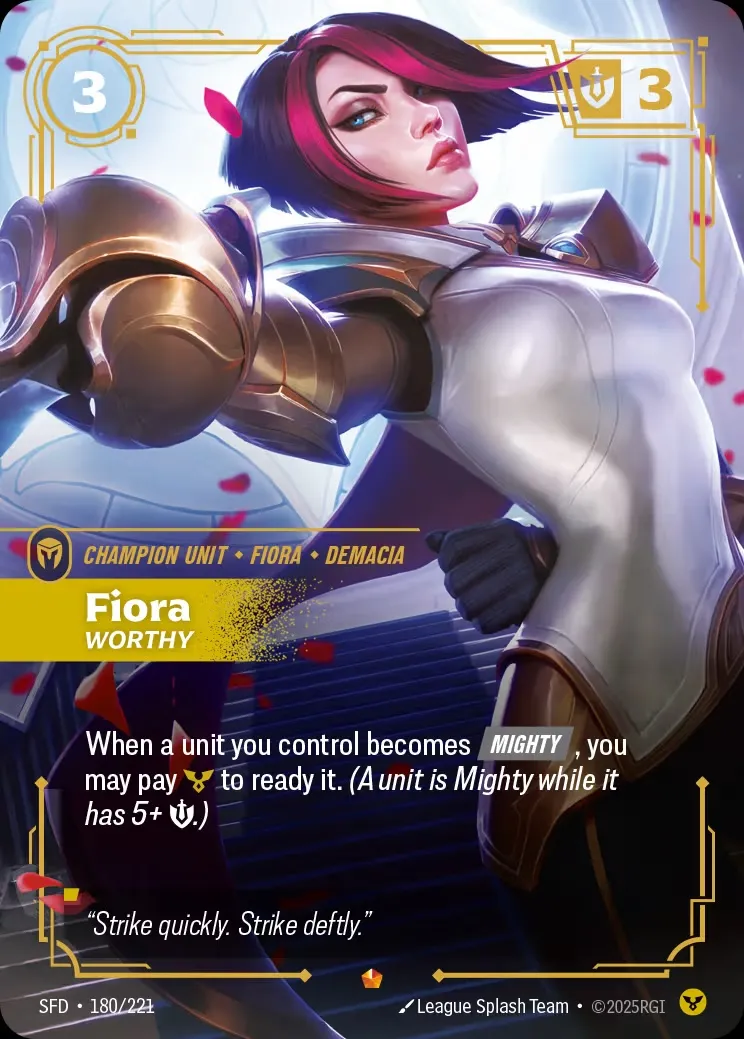
The other preconstructed deck in Spiritforged is Fiora, but admittedly, I didn’t come away as impressed compared to Rumble. There’s nothing wrong with Fiora’s Legend card or Champions on their own, but as an entire deck, Fiora just isn’t nearly as fun to play as Rumble, and those connections and combos are more difficult to come by in the heat of battle.
Fiora is built on the Mighty keyword, and a Unit becomes nightly when it has 5 or more Might. Fiora’s Legend card, Grand Duelist, allows you to exhaust it when one of your units becomes Mighty, and that allows you to channel 1 rune exhausted. If you can get this system working, the idea is that you are building up your Rune resources more quickly than your opponent, and that means you can start paying for more expensive units sooner than your opponent as well. That’s great in theory, but in my time playing her, that just didn’t come to fruition all that often.
There are a host of cards in the deck that give you might bonuses when fulfilling certain requirements, and if those are hit, you should trigger that Mighty keyword. There are also cards that reward you with bonuses when you have a Mighty unit in play, so the foundation is there, but what happened to me more times than not was that a number of units would be right below that threshold, even with Buffs in the mix. When I could get a few Mighty units in the mix, the deck proved quite fun and rewarding, but it just wasn’t as satisfying to play as Rumble, and some of the other Leaders have much more interesting abilities, so I’ll likely not be replaying this deck all that often.
4. Love: I Love Gold!

While Equipment was the biggest addition to Riftbound, Spiritforged also introduced a few other upgrades, and one of those is Gold. Various Legends and Champions generate Gold Tokens, and these Tokens give you the ability to spend 1 Gold (kill the card) to gain 1 Power of any domain.
If we’re just talking about one Gold Token, the impact of having 1 energy of any domain at the exact time you need it is already big, but that goes up exponentially when you have several cards and effects generating Gold over the course of a few turns. Then you suddenly have this power bank available to you in the late game when you need to bring some higher-cost units or gear onto the battlefield, giving you even more key options when in the most intense moments of the game. There are several upgrades to Riftbound in Spiritforged, but don’t sleep on gold.
3. Hated: Battlefields Are A Mixed Bag

While Gold is grand, you will be interacting with battlefields to an even greater degree. You’ll each have 1 battielfied on the board at any given time in a 2-player game, and when you switch out bases between games, you can see how much of an effect they can have on the experience. That’s why it’s a bit disappointing that Spiritforged’s battlefields are somewhat of a mixed bag.
To be clear, there are some fantastic battlefields in Spiritforged, and they can have big impacts in any given round. Power Nexus lets you pay 4 power to score a point, for example, while Forgotten Monument won’t let you score there until turn three. Other standouts include Marai Spire and Emperor’s Dais, though the latter requires a Sand Soldier-focused deck to really take advantage of.
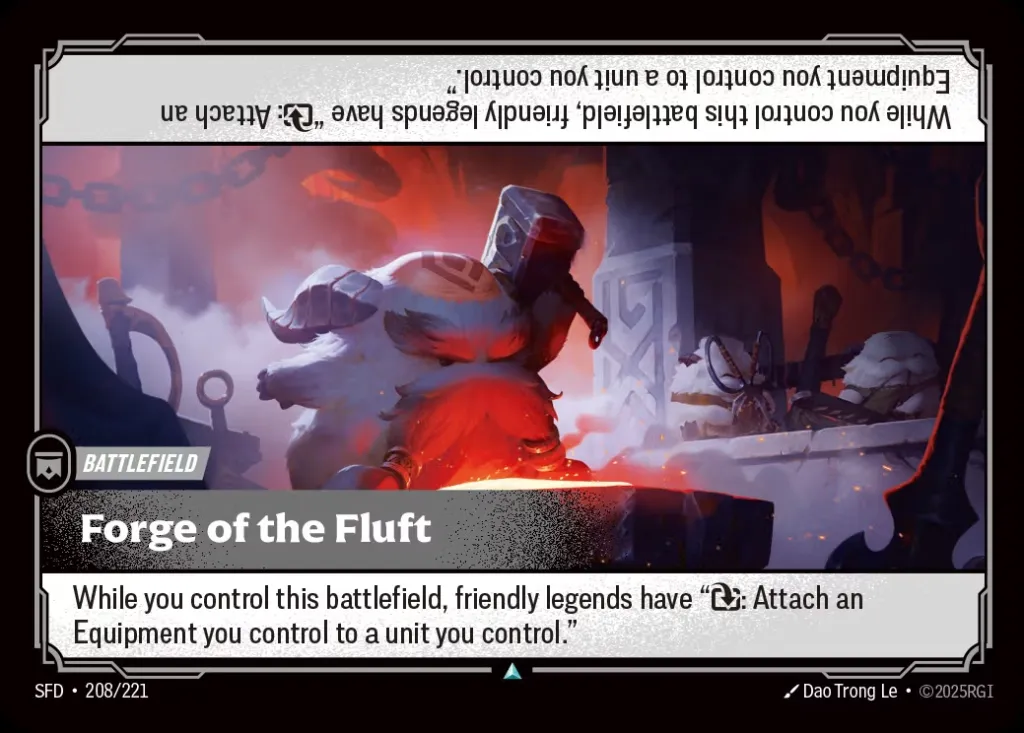
Unfortunately, there are a lot of bases in Spiritforged that are either not all that interesting or just don’t have any sort of major impact on how battles and overall games play out. Sunken Temple’s Mighty-themed effect is fine, but it ties into the overall lackluster Mighty keyword from this set in general.
Veiled Temple is useful in specific instances, but most times it doesn’t come into play, and the same can be said for Hall of Legends, which sounds cool in theory but just didn’t get used all that often in my games. Forge of the Fluft, The Papertree, and Seat of Power all sort of fit that bill, as while they may impact the game every once in a while, more times than not, you could swap them for anything else and have the same experience.
2. Love: Repeat Is A Powerhouse
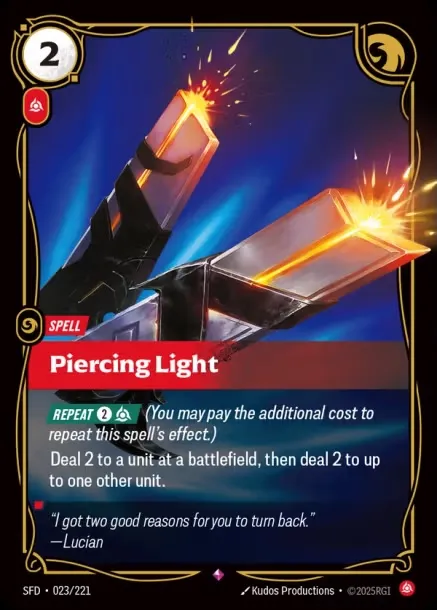

In addition to Equipment, one of the other big keyword additions to Riftbound is Repeat, which is attached to spells and occasionally other cards. As the name implies, it allows you to pay an additional cost to use the effect a second time, and depending on the card being used, it can have a huge effect on any given scenario.
For instance, if you utilize Piercing Light, you can deal 2 damage to a unit at a battliefed, and then 2 damage to up to one other unit. If you pay an additional 2 cost, you can repeat that, and with some of the lower cost units in the mix, you could easily wipe out an entire battlefield with just that one card. Hard Bargain, on the other hand, gives you options to counter a spell unless its controller pays 2 cost, and then you can repeat this for only the cost of 2.
There are also higher cost Repeat effects, but they are often worth it. Marching orders lets you choose a friendly unit anywhere and an enemy unit at a battlefield, and they deal damage equal to their Might to each other, and then you can repeat this effect for a cost of 3. Again, like the former example, you can take out some major units this way or at least start to whittle down a major force at a battlefield. Rocket Barrage, on the other hand, gives you two choices: you can either deal 4 damage to a unit in a base, or kill a gear, and for four cost, you could repeat this, allowing you to take out some enemies before they can even make it to a battlefield to cause havoc.
1. Love: Shining Leaders
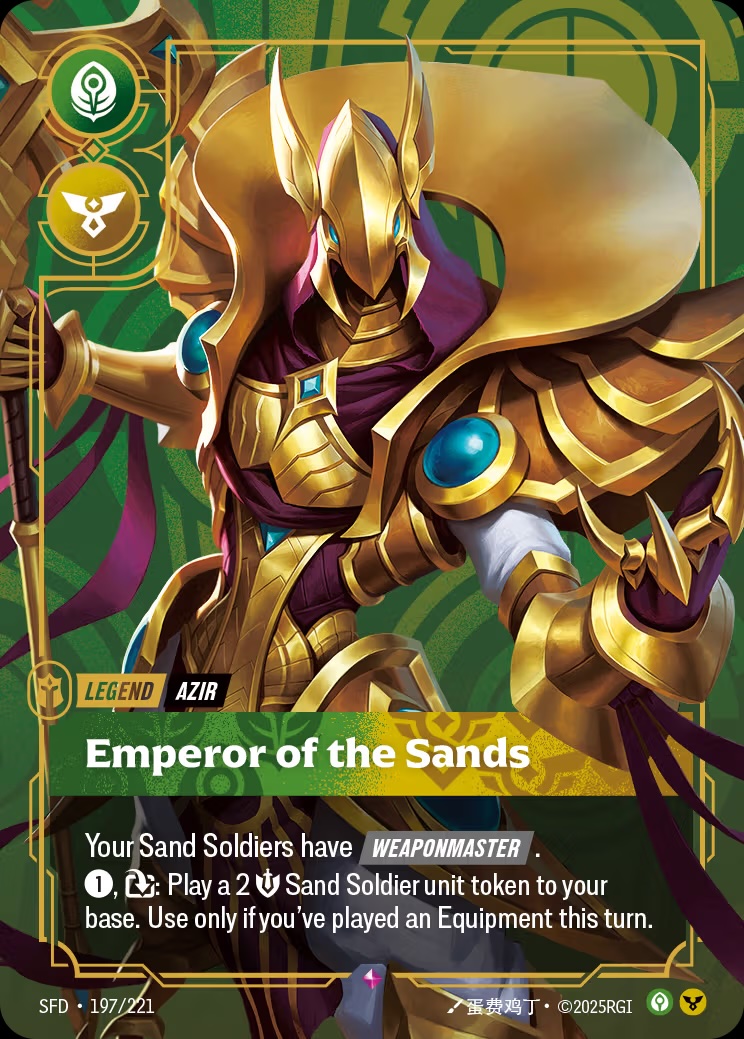

For our final entry, it’s time for a shoutout to the Legends of Spiritforged. There are 12 new Legends in the set, and with the right build, they are all compelling, though a few stand out more than others.
Some of my favorites include Chem-Baroness, who not only features an awesome design but also has an ability that allows you to exhaust her and play a Gold gear token. Then, when your score is within 3 points of Victory (which is 8), your Gold can add an additional 1 energy. Then there’s Emperor of the Sands, who brings together the various Sand Soldier-related cards and gives them weapon master. Plus, you can exhaust him and pay an energy to playa 2 Might Sand Soldier Unit Token to your base, though you have to have planned an Equipment this turn.
Other highlights include Battle Mistress, who lets you also utilize Gold gear tokens when you recycle runes, and she can ready when one or more units die. Lucian allows your equipment to give Assault (+1 Might) while the equipped unit is an attacker, and Draven lets you draw 1 when you win a combat, and that is incredibly handy during the late game turns.
Overall, Riftbound Spiritforged is an excellent set and makes an already stellar game more complex and tactical without overwhelming what made the game so fun in the first place, and if you haven’t given the game a chance yet, I can’t recommend it enough.
Riftbound Spiritforged is in stores now.
What do you think? Leave a comment below and join the conversation now in the ComicBook Forum!